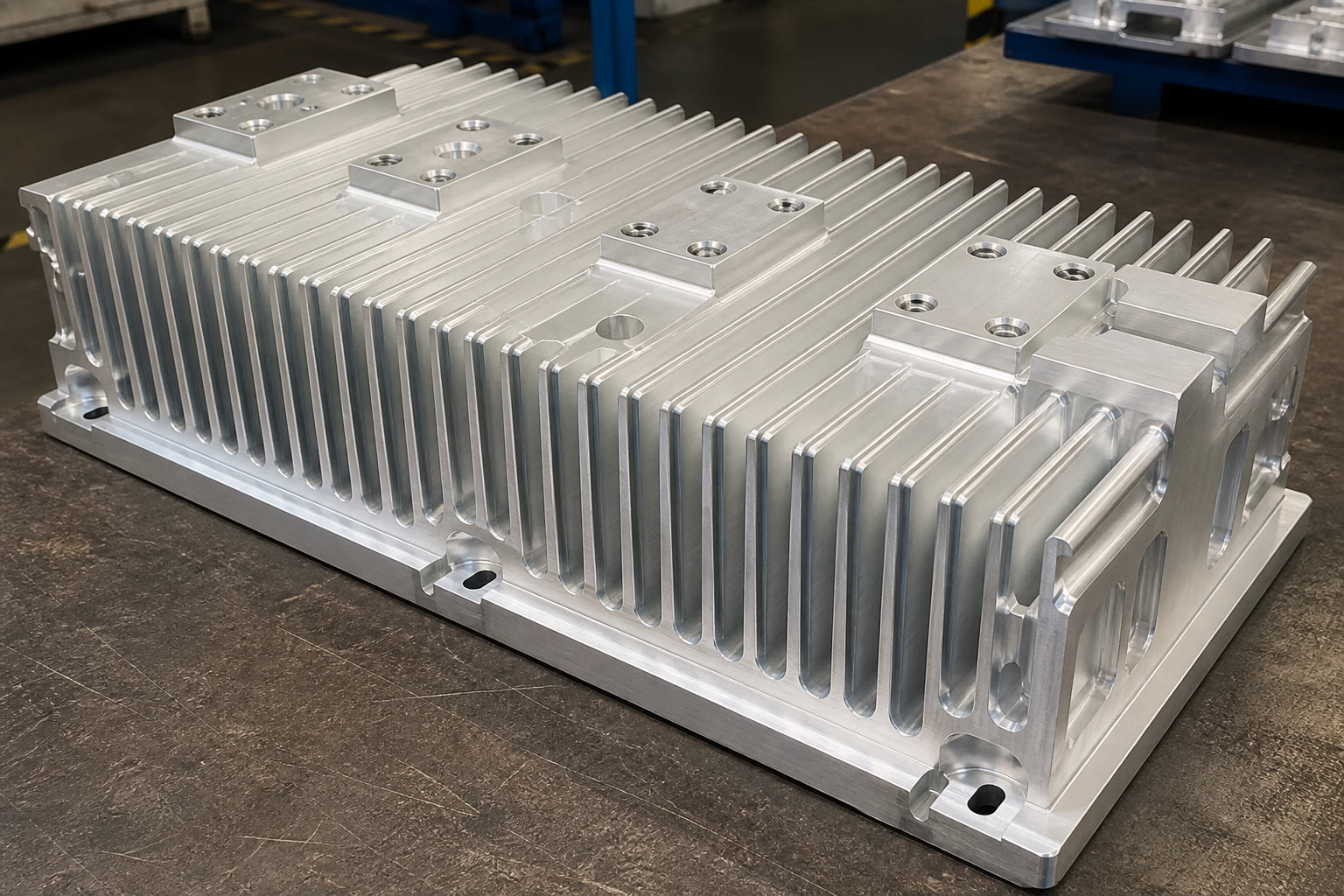
Inverter Heat Sink Manufacturer for High-Power Electronics
HeatsinkMaker designs and manufactures custom inverter heat sinks and liquid-cooled thermal assemblies for PV/ESS inverters, motor drives, EV power electronics, UPS and industrial automation.
Since 2014, we have helped engineering-driven OEMs turn thermal requirements and 2D/3D drawings into manufacturable, repeatable cooling solutions—from prototype to mass production.
2014
Engineering partnership since
±0.002
mm CNC capability
Why HeatsinkMaker
Engineering depth from first concept to stable production
Our supply chain combines thermal engineering, mechanical design, process selection, inspection and production scale-up under one coordinated program.
Engineering-first development
Thermal solution development, mechanical design, DFM and process selection matched to your application.
Multiple technologies
Skiving, extrusion, FSW, forging, bonded fins, heat pipes, machining and liquid cooling in one supply chain.
Controlled scale-up
Prototype, validation, pilot run and mass production with process capability and quality controls.
Tested for reliability
Thermal resistance, leakage, pressure, dimensional, surface and cleanliness inspections support continuous-duty use.
Application requirements
Built for inverter thermal challenges
We design around the electrical, mechanical, environmental and cost constraints that determine real-world inverter performance.
Power density and hotspots
Control concentrated heat from IGBTs, MOSFETs, drivers and DC busbars.
Airflow limitations
Balance fin geometry, variable airflow and pressure-drop limits inside compact enclosures.
Harsh environments
Support wide ambient ranges, dust-laden PV/ESS sites and industrial operating conditions.
Electrical and corrosion control
Address isolation, creepage, clearance and corrosion resistance requirements.
Interface reliability
Maintain repeatable mounting, flatness and planarity for reliable TIM interfaces.
Volume economics
Optimize thermal performance, manufacturability, unit cost and lifecycle targets together.
Custom manufacturing options
Select the right cooling route for your inverter platform
Skived fin heat sinks
High densityA single aluminum or copper block creates dense fins with no fin-to-base interface, reducing thermal resistance.
- Fin thickness: 0.2–3.0 mm; down to 0.05 mm capability
- Fin gap: 0.2–10 mm; down to 0.05 mm capability
- Fin height: up to 150 mm in aluminum and 60 mm in copper
- Processing length: up to 3,500 mm
Extruded heat sinks and FSW assemblies
Custom 6061/6063 aluminum profiles receive CNC machining, drilling, tapping and anodizing. FSW joins ultra-wide or multi-extrusion structures.
- Fin aspect ratios above 20:1 depending on geometry
- FSW assemblies up to approximately 762 mm wide
- FSW fin aspect ratios above 40:1 depending on design
Cold forged pin-fin heat sinks
Integrated round, oval or straight pins provide robust cooling structures for forced or cross-flow applications.
High aspect ratio up to 35:1 for compact drives and sealed enclosures.
Bonded, zipper and stamped-fin modules
Flexible fin geometry and density support targeted airflow paths, medium-volume production and complex fin arrays.
Heat pipe integration is available for hotspot spreading.
Heat pipe assisted heat sinks
Copper heat pipes integrated into aluminum or copper bases spread concentrated device heat across a larger fin area.
Soldering, brazing and nickel plating support application-specific reliability needs.
Liquid cold plates
High heat fluxWhen air cooling is insufficient, custom liquid cold plates deliver low thermal resistance for inverter cabinets, skid-mounted ESS, EV power modules and compact enclosures.
- Vacuum-brazed aluminum structures, typically above 10 bar depending on design
- Embedded, exposed, full-buried, half-buried and sandwiched copper tubes
- CNC-machined flow channels and custom microchannel structures
- Leakage, pressure, thermal and dimensional testing
Engineering before manufacturing
A high-performance inverter heat sink is engineered—not just machined.
Our team evaluates thermal, mechanical, environmental and commercial inputs before recommending an air-cooled heat sink, heat pipe module or liquid cold plate.
Thermal development
Simulation support, thermal resistance testing and validation builds.
Mechanical design
Detailed drawings, mounting review and design for manufacturability.
Process selection
Cost-performance optimization across multiple manufacturing routes.
Quality inspection
Dimensional, CMM, surface, cleanliness and leakage inspection.
Technical reference
Materials, finishes and capability highlights
Material and surface treatment choices are selected for thermal transfer, corrosion resistance, durability, emissivity and interface reliability.
| Area | Available options |
|---|---|
| Materials | Aluminum 1060, 6061, 6063; Copper C1100 |
| Fin structures | Skived, extruded, FSW, forged, bonded, zipper and stamped fin designs |
| Finishing | Anodizing, hard anodizing, nickel plating, passivation, sandblasting, polishing and cleaning |
| Skived capability | Fin gap and thickness down to 0.05 mm; height up to 140 mm aluminum / 60 mm copper; length up to 3,500 mm |
| Precision machining | Machine capability of ±0.002–±0.008 mm |
| Heat pipes | Typical Ø8 mm with custom routing and quantity per application |
Quality and production
Built for repeatable production
- Thermal resistance testing for air-cooled heat sinks
- Leakage and pressure testing for cold plates
- Dimensional and CMM inspection, 2D measurement and surface inspection
- Cleanliness and finishing controls for long-term reliability
Representative equipment
50 CNC machining centers, skiving machines, FSW, 30–200T stamping, soldering and brazing lines, ultrasonic cleaning and 8 assembly lines.
Monthly production capability
Applications
Thermal solutions across power electronics
Cooling route selection
Match the design to the operating condition
Skived fin
High fin density and low thermal resistance for compact forced-air inverter enclosures.
Extruded / FSW
Cost-effective for volume; FSW supports ultra-wide assemblies and large inverter bases.
Cold forged
Robust pin-fin structures for crossflow or multi-directional airflow.
Heat pipe module
Spreads hotspots to a larger fin area without overgrowing the footprint.
Liquid cold plate
For high heat flux, sealed cabinets, high ambient conditions or acoustic constraints.
Production journey
From prototype to production
Prototype
Rapid builds for initial thermal and mechanical validation.
Validation
Testing and optimization against application requirements.
Pilot run
Process capability review and quality locking before scale-up.
Mass production
Stable yields, repeatable inspection and cost control.
Request an engineering review
Send your inverter thermal requirements
Share your project and our engineering team will recommend a manufacturable path aligned with your thermal and cost targets.
For a fast quote, include:
- 2D drawings and/or 3D CAD files
- Heat load in watts and allowable device temperature
- Heat source size, layout, ambient temperature and airflow details
- Installation space, flatness and mounting requirements
- Annual volume and target cost
Discuss your cooling solution
Contact HeatsinkMaker for custom inverter heat sinks and liquid cooling solutions built for production.