Brazing Heat Sink Solutions for High-Power Electronics
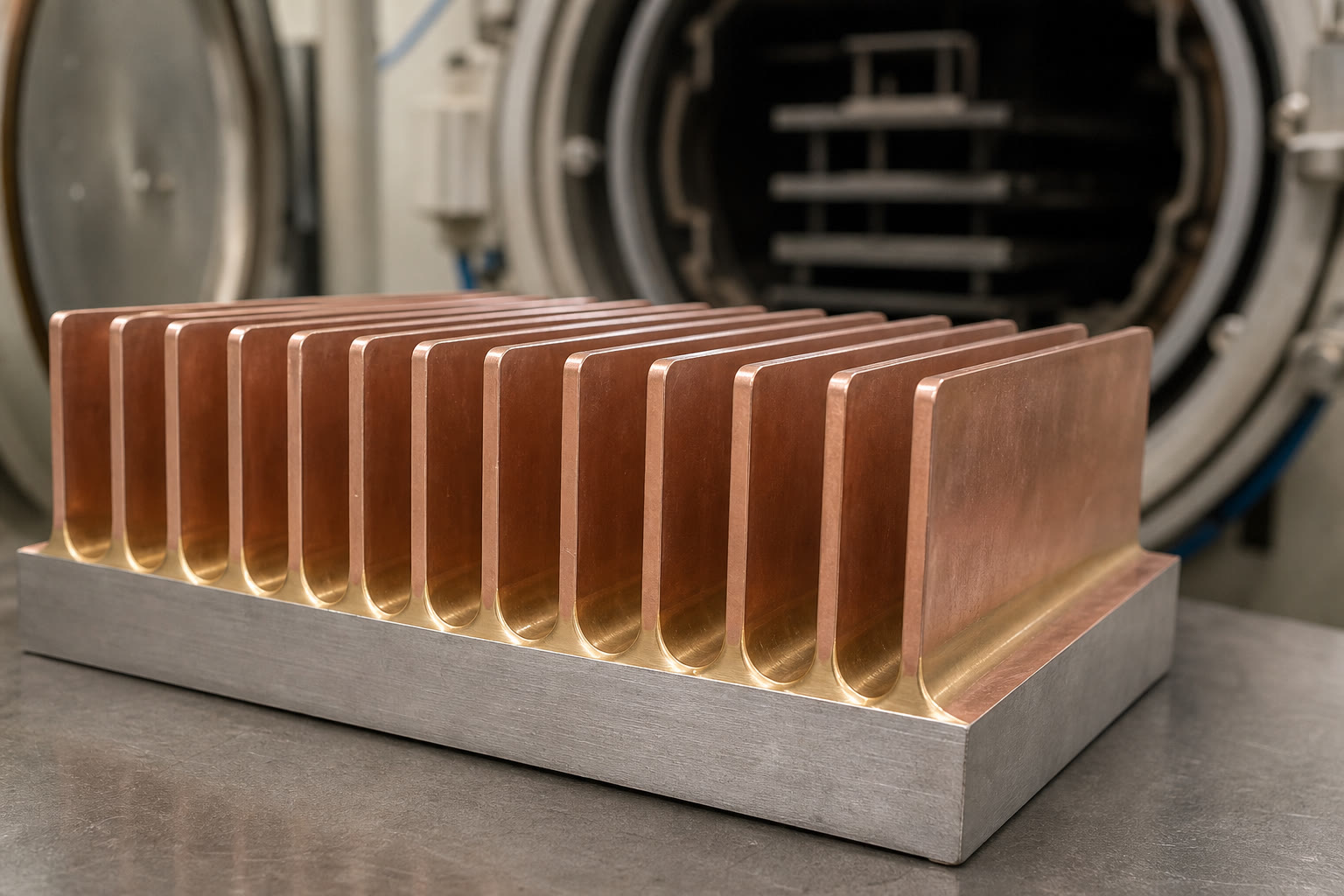
HeatsinkMaker manufactures custom brazed heat sinks and thermal assemblies that balance thermal performance, mechanical robustness and manufacturability.
From thermal design and DFM review to prototyping, vacuum brazing and mass production, we turn drawings and thermal requirements into repeatable, production-ready cooling solutions.
2014
Engineering experience
10+ bar
Possible cold plate pressure
2D / 3D
Drawing-led development
Engineering focus
Heat load, airflow, materials, fin geometry, pressure drop and cost.
Why brazing
Build complex thermal architectures with confidence
Brazing enables high-performance heat sink architectures that are difficult or impossible to achieve through a single forming process. When designed and executed correctly, the result combines low joint resistance, high surface area and durable assembly strength.
High-density fin joining
Join dense fins to aluminum or copper bases without excessive thermal resistance.
Complex assemblies
Combine dissimilar components, heat pipes and spreaders in a single thermal solution.
Large-format designs
Create multi-piece assemblies beyond single extrusion limits, including FSW-supported bases.
Sealed structures
Support pressure, leakage and thermal testing for demanding cold plate and sealed applications.
Integrated manufacturing
Brazing heat sink capabilities under one supply chain
We select brazing only when it provides clear value versus extrusion, skiving, cold forging or bonded fin construction, then combine technologies where a hybrid design delivers a better result.
Materials
Aluminum 1060, 6061 and 6063; Copper C1100.
Processes
Vacuum brazing, soldering, bonded fin, skiving, extrusion, CNC machining and FSW.
Fin architectures
Skived, stamped, zipper, folded, bonded and stacked fins brazed or soldered to bases.
Finishing
Anodizing, hard anodizing, nickel plating, passivation, sandblasting and polishing.
Engineering and verification
Thermal solution development, mechanical design, DFM and simulation support.
Thermal resistance testing, dimensional and CMM inspection.
Heat pipes integrated with brazed fin stacks and machined bases.
Leakage and pressure testing for sealed structures.
Liquid cooling
Vacuum-brazed cold plates can be designed for operating pressures above 10 bar depending on geometry and application requirements.
Configuration options
Architectures tailored to your thermal and mechanical targets
Our team can combine brazed, machined, skived and welded elements to fit the heat source, footprint, airflow and reliability requirements.
Brazed fin to base
Stamped, folded or zipper fins joined to aluminum or copper bases.
Skive + braze hybrids
Skived base regions combined with brazed secondary fin arrays.
Heat pipe modules
Heat pipes soldered or brazed into bases to spread concentrated heat.
Multi-piece bases
FSW-joined extrusions with brazed fin stacks for wide footprints.
Plated assemblies
Nickel plating for corrosion control or mixed-metal solderability.
Engineering before manufacturing
Reduce thermal and production risk before the first article
Our engineers collaborate with your thermal and mechanical teams to select the right joining method and prepare the design for repeatable production.
- Define thermal targets, constraints and acceptance criteria.
- Optimize fin geometry for airflow and pressure drop.
- Manage flatness, planarity, joint resistance and galvanic compatibility.
- Prepare the design for validation, pilot and volume production.
Design inputs we can work from
We typically support AutoCAD, SolidWorks and Creo, as well as application inputs.
Select the right process
Brazing versus alternative thermal manufacturing routes
The best route depends on fin density, footprint, materials, volume, testing and total cost. We often recommend hybrid designs.
Brazing
Complex assemblies, high fin density, mixed materials, and sealed or pressure-tested components.
Skiving
Very high fin density with zero fin-to-base interface in a monolithic copper or aluminum part.
Extrusion
Cost-effective for moderate fin density, scalable with post-machining and suitable for many profiles.
Cold forging
Pin-fin arrays and integrated structures without fin draft angles.
Bonded fin
Flexible layouts and fin density, often cost-effective for moderate volumes.
FSW assemblies
Ultra-wide bases made by joining extrusions, with brazed fin arrays added as needed.
Quality and production
Verification built into the production path
Dimensional control
CMM inspection for critical surfaces and flatness.
Thermal testing
Thermal resistance testing to confirm modeled performance.
Pressure assurance
Leakage and pressure testing for sealed structures and cold plates.
Clean assembly
Surface inspection and cleanliness verification before shipment.
Prototype to mass production
Prototype
Rapid builds for design exploration and thermal validation.
Validation
Test articles with defined tolerances and test ports.
Pilot run
Process tuning and stability checks for repeatability.
Mass production
Scaled output with quality controls and documentation.
Applications
Thermal solutions for demanding equipment
Power electronics and motor drives
Solar/PV inverters and energy storage
EV power electronics and charging
Industrial automation and control
Telecommunications and 5G
Servers, AI and computing hardware
Semiconductor, laser and medical equipment
LED, transportation and renewable energy
Application scenarios
Design strategies that solve real constraints
High-density fin upgrade
Replace an extruded sink with a brazed fin-on-base design to increase surface area while retaining the footprint and airflow.
Wide-format base
Use FSW to create an ultra-wide base, then braze fin arrays for uniform airflow across a large inverter module.
Mixed-metal and heat pipe integration
Combine copper spreaders, aluminum fin fields, nickel plating and heat pipes to balance conduction, weight and corrosion control.
Frequently asked questions
Answers for engineering and procurement teams
What is the difference between brazing and soldering?
Brazing uses higher temperatures and typically creates stronger joints with lower thermal resistance. Soldering suits lower-temperature assemblies and specific integrations such as heat pipes.
Can you vacuum-braze aluminum heat sinks?
Yes. We design vacuum-brazed aluminum structures, including cold plates that can be engineered for operating pressures above 10 bar depending on design.
How do you manage galvanic corrosion?
We combine material selection, nickel plating where appropriate and design controls to minimize galvanic coupling and environmental risk.
What data do you need to quote?
Please provide drawings or 3D files, heat load, thermal limits, airflow or coolant parameters, installation envelope, target volumes and test requirements.
Do you only build to print?
No. We support OEM/ODM, build-to-print and custom thermal solution development, including thermal design and DFM support before prototyping.
Start your project
Send your requirements. We will help define the right architecture.
Share your thermal, mechanical and production requirements. HeatsinkMaker will evaluate the application and recommend a manufacturable brazing heat sink solution that balances performance, reliability and cost.
Helpful RFQ information
- 2D/3D drawing and BOM
- Heat load and allowable temperatures
- Heat source dimensions and interface details
- Airflow or coolant parameters
- Available space, mounting method and annual volume
- Thermal, pressure, leakage and dimensional test requirements