Custom Zipper Heat Sinks for High-Power Electronics
We design and manufacture custom zipper heat sinks and heat pipe assemblies — from thermal design and prototyping to mass production. HeatsinkMaker combines stamping, soldering/brazing, CNC machining and heat pipe integration to deliver reliable cooling that meets your thermal, cost and volume targets.
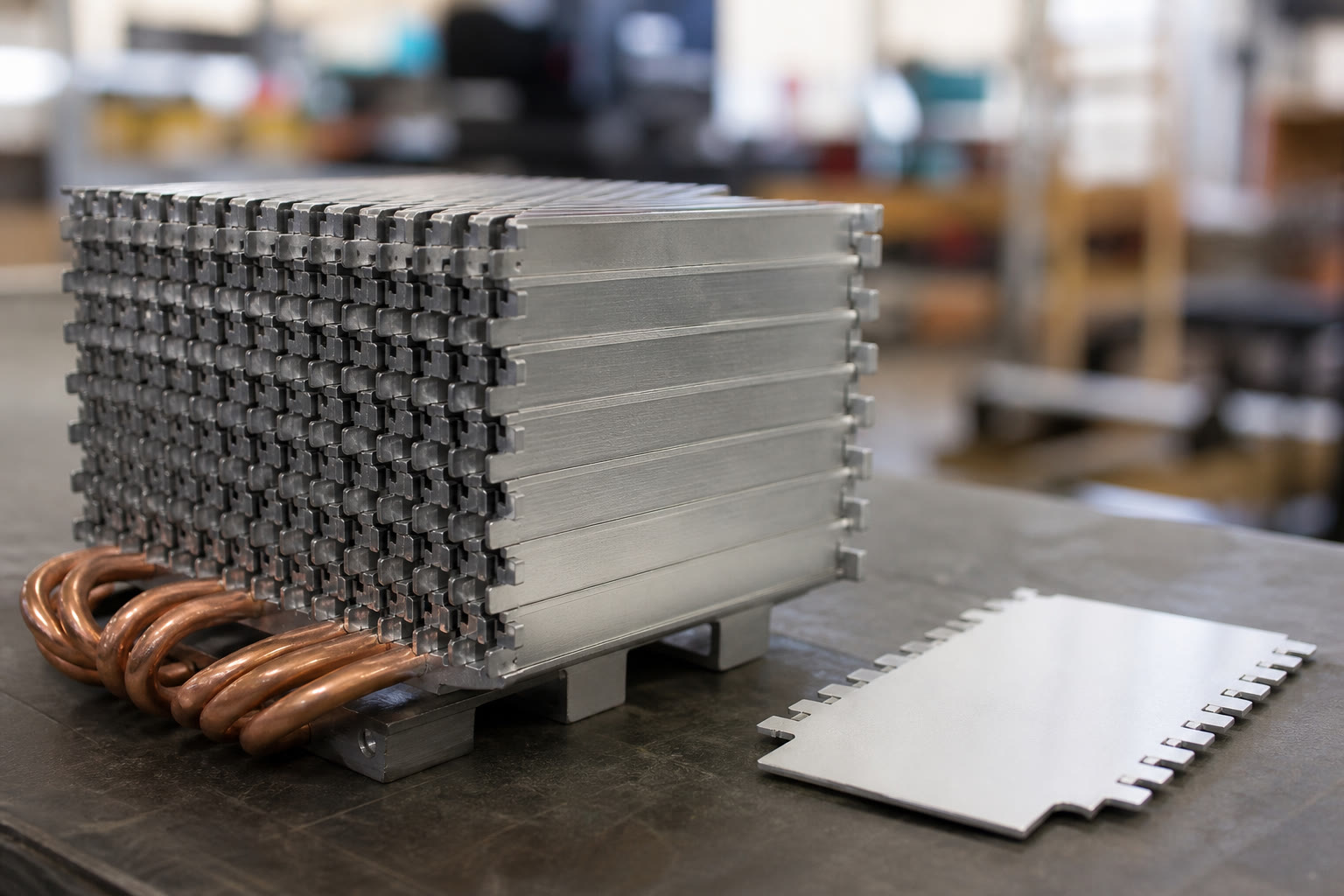
What is a zipper heat sink and why choose it
Zipper heat sinks use thin, stamped aluminum or copper fins that interlock ("zip") and are joined to a base by soldering or brazing. This structure enables very high fin density in a compact envelope — ideal where extrusion cannot deliver enough surface area at the required width or height.
Typical applications include power electronics, inverters and energy storage, EV power modules, motor drives, telecom and 5G gear, servers, lasers, and medical/industrial equipment.
High fin density
Maximized surface area for forced-air cooling within tight mechanical envelopes.
Optimized pitch & height
Thin fins with engineered pitch to balance thermal resistance against pressure drop.
Flexible base options
Aluminum or copper base with CNC features for mounting, threads, and interfaces.
Heat-pipe ready
Easy integration with heat pipes to spread heat from small, concentrated sources.
Scalable production
Stamped fins plus automated joining deliver consistent performance at medium to high volume.
How we build zipper heat sinks
A vertically integrated process from stamping to finishing, with engineering validation at every step before release.
Progressive-die stamping & folding
Interlocking aluminum or copper fins formed in high-speed progressive dies for consistent geometry.
CNC-machined bases
Aluminum 6061/6063 or copper C1100 with required mounting holes, threads and interface features.
Lead-free soldering / brazing
Low thermal-resistance fin-to-base interface with selective soldering for mixed-material modules.
Heat pipes & vapor chambers
Spread heat from small or concentrated sources across a larger fin field.
Anodizing & plating
Anodizing for aluminum, nickel plating for copper — corrosion protection and cosmetic consistency.
Hardware & sub-assemblies
Hole patterns, threads, inserts, dowels, TIM-ready flatness, and interface hardware per drawing.
Thermal & dimensional inspection
Thermal resistance testing under specified airflow, CMM dimensional inspection, and cleanliness checks before release to pilot run and mass production.
A high-performance zipper heat sink starts with engineering
We work closely with your thermal and mechanical teams to ensure the design is manufacturable and repeatable. Our reviews start before any metal is cut, so thermal, cost and volume targets are aligned early.
Drawings or basic application data: heat load, heat source size, airflow, allowable temperature, and space envelope. We will recommend a fin architecture and manufacturing route.
-
A
Thermal solution & architecture selection
Fin-base architecture choice based on heat load, airflow, and envelope constraints.
-
B
DFM review
Stamping, soldering/brazing, machining and assembly reviews for repeatable production.
-
C
Material & process selection
Aluminum vs copper, joining method, and finishing tuned to thermal target, cost and volume.
-
D
Prototypes & validation
Rapid prototypes, optional thermal simulation, and thermal resistance testing before mass production.
Capabilities and options we tailor to your drawing
We tailor fin thickness, pitch, height, base thickness and module size to your thermal resistance, airflow and mechanical requirements — not a fixed catalog geometry.
Fins & bases
- ›Fins: Aluminum 1060/6063 or Copper C1100
- ›Bases: Aluminum 6061/6063 or Copper C1100
Profile & form
- ›Straight or profiled fins, custom pitch and height
- ›Edge treatments and end caps for inlet effects and rigidity
Soldering & brazing
- ›Lead-free soldering or brazing of fin stacks to base
- ›Selective soldering for mixed-material modules
Hotspot management
- ›Copper base inserts for concentrated heat sources
- ›Heat pipes or vapor chambers integrated to low-profile modules
CNC & finishing
- ›Milling, drilling, tapping, countersinking, cross-cutting
- ›Deburring and cleaning
Protection & cosmetics
- ›Black anodizing or hard anodizing (aluminum)
- ›Nickel plating, passivation, sandblasting, polishing
Ready-to-mount modules
- ›TIM-ready surfaces and flatness control
- ›Mounting hardware and sub-assemblies
- ›Integrated fan or shroud sub-assemblies
- ›Final inspection and ultrasonic cleaning
Verified before release, audited during production
Every build follows documented inspection plans. Sample data, certificates and reports are available on request to support your qualification process.
CMM & 2D measurement
Full dimensional inspection per drawing, with CMM and 2D profile checks on critical features.
Thermal resistance testing
ΔT and thermal resistance measured under specified airflow against your acceptance criteria.
Solder / braze verification
Joint quality and cleanliness verified for each lot before sub-assembly or shipment.
Surface & material certs
Finish verification, surface inspection, and material certifications available on request.
One supply chain, prototypes to mass production
Stamping, soldering/brazing, CNC, heat pipes, skiving, cold forging, extrusion, FSW and vacuum brazing are all available under one roof — so your design does not have to be split across vendors.
CNC machining centers
50 sets, ±0.002–±0.008 mm machine capability
Stamping machines
10 sets, 30T–200T for fin production
Soldering & brazing lines
Dedicated lines for thermal assemblies
Hybrid & alternative processes
Skiving, cold forging, extrusion, FSW
8 assembly lines
Ultrasonic cleaning and final inspection integrated into flow
When zipper heat sinks are the right choice
Use this quick guide to see whether zipper fin architecture matches your application, or whether an alternative process should be evaluated alongside it.
- ✓ You need higher fin density than extrusion can provide at the target width / height.
- ✓ Forced-air environments where pressure drop can be engineered via fin pitch and height.
- ✓ Hotspot spreading via heat pipes or vapor chambers integrated into a low-profile module.
- ✓ Medium to high volumes where stamped fins and soldered assemblies offer cost-performance advantages.
- ✓ Mechanical constraints (mounting, flatness, keep-out zones) require a CNC base.
Skived or cold-forged heat sinks
If your design requires ultra-thin fins without joints, skived or cold-forged heat sinks may be evaluated as alternatives. We routinely compare options to meet your targets.
- ›Eliminates fin-to-base interface
- ›Extremely thin fins on certain geometries
- ›Best for smaller, integrated cold plates
Trusted by engineering teams across power, mobility and digital infrastructure
Power electronics, UPS & supplies
High-density converters, rectifiers, and uninterrupted power systems.
Solar inverters & energy storage
String and central inverters, battery management and ESS cooling.
EV power electronics & motor controllers
Traction inverters, onboard chargers, DC/DC converters and motor drives.
Automation & drives
Servo drives, IGBT modules, and industrial process control hardware.
Telecommunications & 5G
RRU/AAU, baseband units, edge compute and outdoor enclosures.
Servers, AI & data centers
CPU/GPU cold plates, accelerator cards, and rack-scale cooling.
Semiconductor & test equipment
ATE handlers, prober stages, and wafer-process hardware.
Medical, laser & optical systems
Imaging subsystems, surgical laser drivers, and optical benches.
Transportation & renewable energy
Rail, charging infrastructure, and wind/solar power conversion.
What to send for the fastest, most accurate quotation
Complete inputs let us return a firm, production-ready quote with manufacturability feedback. We sign NDAs and work build-to-print or as your ODM thermal partner.
Send what you have
A rough application description is often enough for an initial feasibility review. We will help you fill in the thermal inputs and propose a starting architecture.
- ›Even a 1-line description gets the conversation started
- ›NDA available on request
- ›Build-to-print or ODM thermal partnership
An engineering-first thermal partner, not just a parts shop
We act as an extension of your engineering team. Our reviews begin before any metal is cut, and our integrated process chain keeps design intent intact from prototype to mass production.
Discuss your project →-
01
Engineering-first approach
Thermal and DFM reviews before cutting metal — every drawing is reviewed for manufacturability.
-
02
Multiple thermal processes under one roof
Stamping, soldering/brazing, CNC, heat pipes, skiving, cold forging, extrusion, FSW, vacuum brazing.
-
03
Prototype → validation → pilot → mass production
Consistent quality at every stage, with the same engineering team following your program.
-
04
Application-driven design
Fin pitch, height, materials and joining tuned to your airflow, pressure drop and cost targets.
-
05
Global OEM experience since 2014
Working with international engineering teams across power, mobility, telecom and compute markets.
FAQs about custom zipper heat sinks
What's the difference between zipper and skived heat sinks? +
Aluminum or copper fins? +
Can you integrate heat pipes? +
What finishes are available? +
Do you support low volumes? +
Send your drawing and thermal requirements
Our engineering team will review the application, propose a zipper heat sink architecture, and provide a firm, production-ready quotation with manufacturability feedback.
- ✓Engineering review before quotation
- ✓NDA available on request
- ✓Build-to-print or ODM thermal partnership
- ✓Prototypes and mass production in one supply chain